
This week in MathOnco 354
Looking ahead to 2026 in mathematical oncology


“This week in Mathematical Oncology” — Jan 9, 2026
> mathematical-oncology.org
From the editor:
Happy New Year, and welcome back to another edition of the mathematical oncology newsletter!
To kick off the new year of math onco, David Basanta (Moffitt Cancer Center) has written a recap of last year on the math onco blog: A Year in Mathematical Oncology: 2025 Blog Recap, with matching cover artwork by Maximilian Strobl (Imperial College London).
Enjoy,
Jeffrey West
jeffrey.west@moffitt.org
PS I’ll also note that a couple math onco related special issues have been extended into 2026 (see the bottom of this email).

ALFA-K: Local adaptive mapping of karyotype fitness landscapes
Richard J. Beck, Tao Li & Noemi AndorRecent advances in ODEs modeling of tumor-immune responses: a focus on delay effects.
Arredondo JA, Rivera A.The inherent fragility of collective proliferative control.
Caldwell MG, Lander AD.Integrating machine learning into the in silico clinical trial pipeline.
Bekker RA, Brady-Nicholls R, de Pillis L, Gevertz JL, Jain HV.A mathematical investigation of exosome and lactate levels interplay in an in vitro and in vivo tumors
Gopinath SadhuMathematical Modeling Quantifies “Just-Right” APC Inactivation for Colorectal Cancer Initiation
Meritxell Brunet Guasch, Nathalie A. Feeley, Ignacio Soriano, Steve Thorn, Ian P.M. Tomlinson, Michael D. Nicholson, Tibor AntalEmergent stable tissue shapes from the regulatory feedback between morphogens and cell growth
Bivash Kaity, Daniel LoboSpaceBar enables single-cell-resolution clone tracing with imaging-based spatial transcriptomics
Grant Kinsler, Caitlin Fagan, Haiyin Li, Jessica Kaster, Maggie Dunne, Robert J. Vander Velde, Ryan H. Boe, Sydney Shaffer, Meenhard Herlyn, Arjun Raj & Yael Heyman

Age and Generation-Based Model of Metastatic Cancer
Panagiotis Gavriliadis, Georgios Lolas, Themis MatsoukasPhytClust: efficient and optimal node clustering in phylogenetic trees
Katyayni Ganesan, Elisa Billard, Tom L Kaufmann, Cody B Strange, Maja C. Cwikla, Adrian M. Altenhoff, Christophe Dessimoz, Roland F. SchwarztugMedi: simulator of cancer-cell evolution for personalized medicine based on the genomic data of patients
Iurii Nagornov, Eisaku Furukawa, Momoko Nagai, Shigehiro Yagishita, Tatsuhiro Shibata, Mamoru KatoVirtual Clinical Trials of BMP4 Differentiation Therapy: Digital Twins to Aid Successful Glioblastoma Trial Design.
Harbour N, Curtin L, Michaelides L, Hubbard ME, Jackson P, Rani V, Kenchappa RS, Farias VA, Carrano A, Owen MR, Quinones-Hinojosa A, Swanson KR.Integrating Mathematical and Mouse Models Identifies T Regulatory Cell Influx as A Key Determinant of Acquired Resistance to PD-1 Immunotherapy.
Sousa RS, Geels SN, Murat C, Moshensky A, Villalta SA, Lowengrub JS, Marangoni F.The Mixed Birth-death/death-Birth Moran Process
David A. Brewster, Yichen Huang, Michael Mitzenmacher, Martin A. NowakMetastability in the mixing/demixing of two species with reciprocally concentration-dependent diffusivity
Alexander B. Neiman, Xiaochen Dong, Benjamin Lindner

A Year in Mathematical Oncology: 2025 Blog Recap
The Mathematical Oncology Blog
David Basanta: “As 2026 starts, I always like to take advantage of my role as editor of this blog to continue with the annual tradition: stepping back to reflect on the journey our community has taken over the past year.“9th International Conference on the Virtual Physiological Human
VPH 2026 will take place in Milan (Italy), 1–4 September 2026.
VPH is the flagship conference of The Society for In Silico Medicine, an international scientific community whose mission is to advance in silico medicine worldwide. The central theme of VPH 2026 is the adoption of digital twins in healthcare, with a strong emphasis on methodological innovation, translational impact, and clinical integration.

The newsletter now has a dedicated homepage where we post the cover artwork for each issue, curated by Maximilian Strobl, Sarah Groves, and Veronika Hofmann. We encourage submissions that coincide with the release of a recent paper from your group. This week’s artwork:
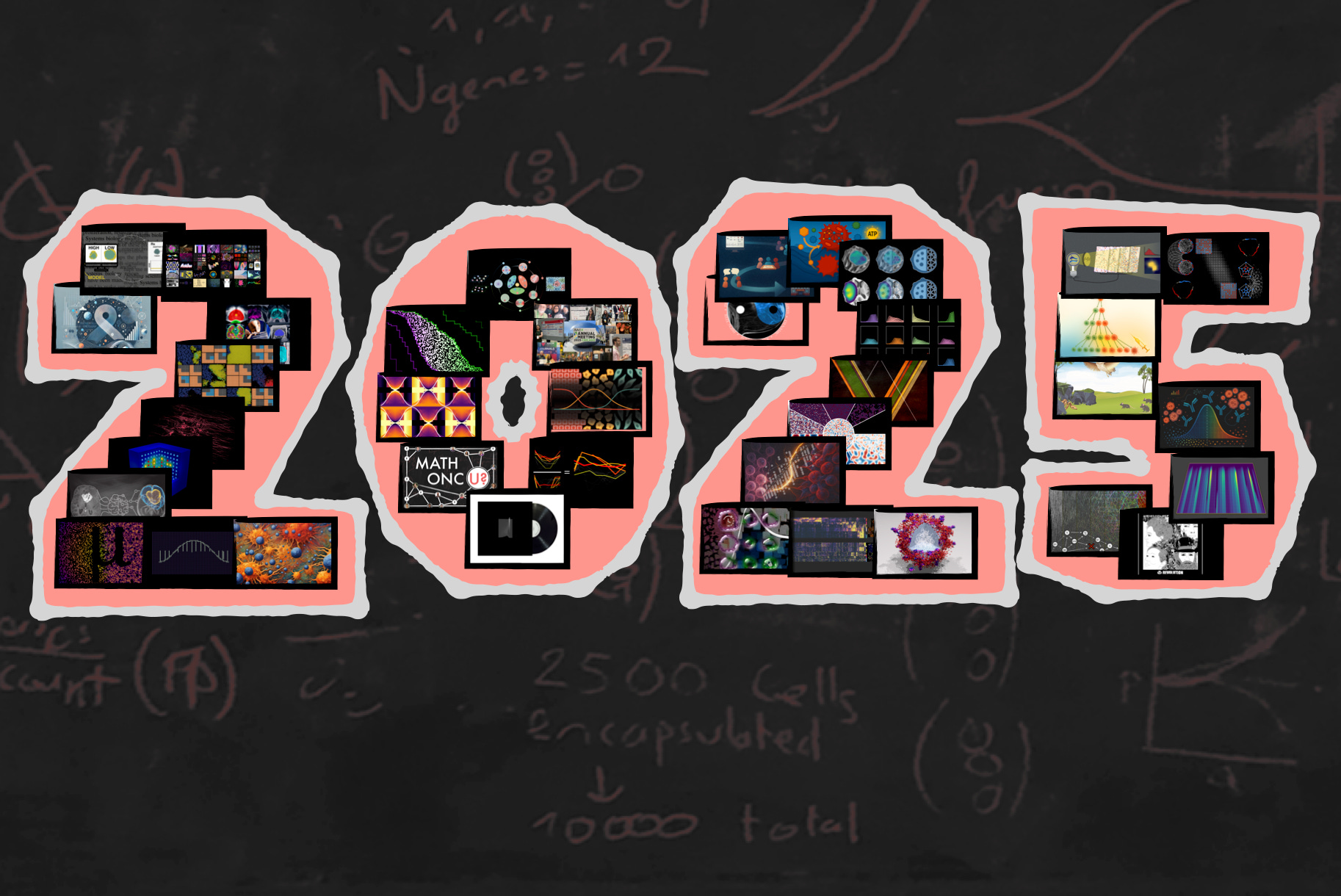
Artists: Maximilian Strobl
Caption: 38 covers – that is our tally for 2025! Ranging from depictions of spatial point patterns (#324), negative spaces between Kaplan-Meier curves (#329), antifragility (#339), and the structure of our Mathonco community (#340, #347), the artists in our ranks have again outdone themselves.
I still remember the lunch time conversation I had with Jeffrey West in which we first discussed the idea of cover artwork for the newsletter. We thought it would be fun and decided to run a trial for a few weeks. That was now almost 5 years ago, and this year we published our 200th cover – an incredible milestone, which would not have been possible without the effort every single one of our artists has put in (and there are more than 70 of you now). In addition, I want to thank my co-editor Sarah Maddox Groves for all her hard work this year, and welcome Veronika Hofmann to the team, who joined over the summer and has already helped to curate some amazing pieces!
For those of you who recently joined our community: every week we feature a piece of artwork which was created from a recently published paper or preprint (see my blog post for more details on the process). Importantly, while our artwork editorial team stands by to assist, the authors are the lead artists behind their piece. Intrigued, but don’t think you have an artistic streak? Don’t worry and reach out to us. We always love to hear from you and are happy to help.
P.S. Three groups took inspiration from famous album covers – can you spot them?

Visit the mathematical oncology page to view jobs, meetings, and special issues. We will post new additions here, but the full list can found at mathematical-oncology.org.
1. Jobs
The special issue in Evolution, Medicine and Public Health called “Exploring Eco-Evo Applications In Cancer” is due June 2026.
The special issue in Mathematical Biosciences called “Mechanistic learning in biomedical sciences” is due July 2026.
The special issue in Frontiers in Artificial Intelligence called “Role of AI in Translational Medicine” is due 31 May 2026.
Approximate current subscriber count, N:
N(t) = 0.808t+80 (where t = days since Dec. 1st, 2017)