
This week in MathOnco 359
PSI, peer review & paper bananas


“This week in Mathematical Oncology” — Feb 12, 2026
> mathematical-oncology.org
From the editor:
Peer review is a valuable service to the community, but it can be difficult for editors to find reviewers. On the flip side, I often meet early-career researchers who are interested in participating in peer review, but have not been invited. If you’d like me to circulate your availability to review math onco work, please add your contact information to this form, along with your research interests:
Enjoy,
Jeffrey West
jeffrey.west@moffitt.org

Hallmarks of cancer—Then and now, and beyond
Douglas HanahanCancer, Collapse and the Politics of Somatic Evolution
Michel Salzet
Can evolutionary therapy be applied in non-small cell lung cancer?
Laura R. Jansén-Storbacka, Kailas S. Honasoge, Eva Molnárová, …, Ron H. J. Mathijssen, Anne-Marie C. Dingemans & Kateřina StaňkováSynthesizing scientific literature with retrieval-augmented language models
Akari Asai, Jacqueline He, Rulin Shao, …, Wen-tau Yih, Pang Wei Koh & Hannaneh HajishirziA microenvironment-determined risk continuum refines subtyping in meningioma and reveals determinants of machine learning-based tumor classification.
Maas SLN, …. Sahm F.VUScope: a mathematical model for evaluating image-based drug response measurements and predicting long-term incubation outcomes
Nguyen Khoa Tran, My Ky Huynh, Alexander D Kotman, Martin Jürgens, Thomas Kurz, Sascha Dietrich, Gunnar W Klau, Nan Qin

Hierarchical organization in sparse gene regulatory networks shapes structural coherence and emergent regulatory coordination
Pradyumna Harlapur, Rahul Jagadeesan, Andre Sanches Ribeiro, Claus Kadelka, Mohit Kumar JollyPseudodynamics+: Reconstructing Population Dynamics from Time-Resolved Single Cell Landscapes with Physics Informed Neural Networks
Weizhong Zheng, Melania Barile, Nicola K. Wilson, Yuanhua Huang, Fabian J. Theis, Berthold Göttgens

Automating Academic Illustration
An agentic framework for AI researchers. Generate high-quality methodology diagrams and plots from text or references with PaperBanana.

The newsletter now has a dedicated homepage where we post the cover artwork for each issue, curated by Maximilian Strobl, Sarah Groves, and Veronika Hofmann. We encourage submissions that coincide with the release of a recent paper from your group. This week’s artwork:
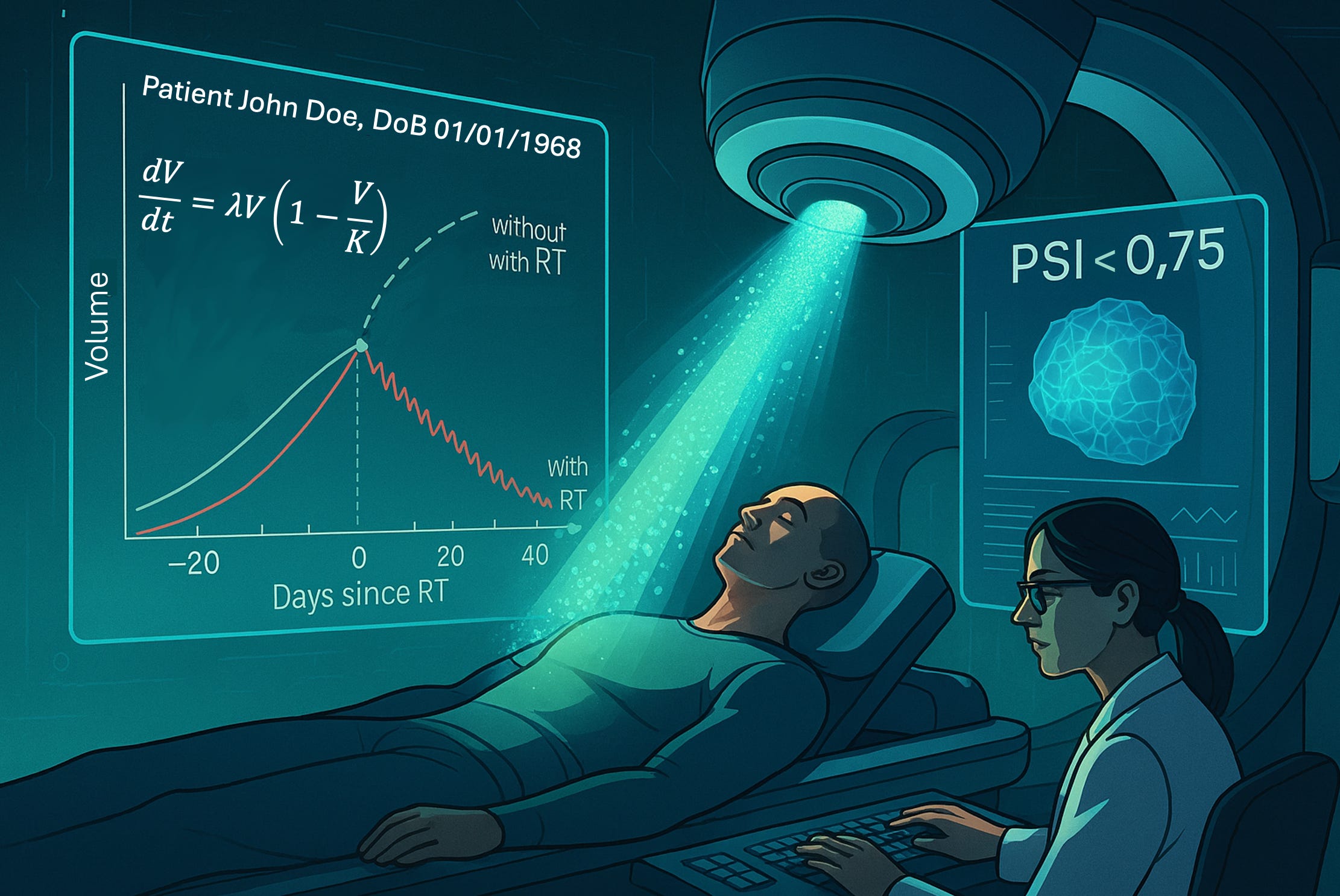
Based on the paper: Phase II Prospective Trial of Personalized Radiotherapy Fractionation in Human Papillomavirus Positive Oropharyngeal Cancer published in Int J Radiat Oncol Biol Phys.
Artist: Heiko Enderling
Caption: Our Phase II study tested a personalized approach to radiation therapy (RT) for oropharyngeal cancer in which the patient’s treatment plan was directly guided by a mathematical model. The proliferation saturation index (PSI) model derives the proliferating and radiosensitive proportion of a tumor based on clinically observed net growth before therapy. Numerical simulations demonstrated that higher PSI may be better treated with smaller but more frequent radiation doses. Based on simulations, we hypothesized that personalization of fractionation using PSI would increase the percentage of patients achieving a rapid reduction in tumor size during RT. This clinical study validated our hypothesis, showing that personalized RT fractionation based on PSI achieves a promising rate of midtreatment response with favorable LF, PFS, and OS.

Visit the mathematical oncology page to view jobs, meetings, and special issues. We will post new additions here, but the full list can found at mathematical-oncology.org.
1. Jobs
Approximate current subscriber count, N:
N(t) = 0.808t+80 (where t = days since Dec. 1st, 2017)
Thanks for sharing this week's MathOnco update! I appreciate the editor's note about connecting early-career researchers with peer review opportunities. The list of topics, like evolutionary therapy in lung cancer, looks fascinating too.