
This week in MathOnco 362
Growth dynamics, adaptive therapy, PINNs, resistance dynamics, chemotaxis, and more.


“This week in Mathematical Oncology” — March 5, 2026
> mathematical-oncology.org
From the editor:
Welcome to another edition of the math oncology newsletter! This week we have papers on topics like growth dynamics, adaptive therapy, PINNs, resistance dynamics, chemotaxis, and more.
Enjoy,
Jeffrey West
jeffrey.west@moffitt.org
TWiMO is brought to you by Maximilian Strobl, Sarah Groves, Veronika Hofmann, Yifan Chen, Franco Pradelli, and Sandy Anderson. Find out more about the team here.

Community assembly modeling of the microbiome within Barrett’s esophagus and esophageal adenocarcinoma
Caitlin Guccione, Igor Sfiligoi, Antonio Gonzalez, Justin P. Shaffer, Mariya Kazachkova, Yuhan Weng, Daniel McDonald, Shailja C. Shah, Samuel S. Minot, Thomas G. Paulson, William M. Grady, Ludmil B. Alexandrov, Rob Knight, Kit CurtiusGompertz growth with a shared carrying capacity optimally simulates primary and metastatic tumor growth dynamics.
Schlicke P, Korangath P, Pan X, Ercan C, Gabrielson K, Werhane L, Yuan Y, Benzekry S, Ivkov R, Enderling H.External Validation of The Proliferation Saturation Index Model in Predicting Tumour Volume Regression in Patients with Non-Small Cell Lung Cancer Undergoing Radiation Therapy.
Barrett S, Zahid M, McGarry CK, Enderling H, Walls GM, Marignol L.Retrograde longitudinal imaging analyses of IDH-wildtype glioblastoma reveal its clinical timeline from radiological birth to death.
Shigeeda R, Shibahara I, Orihashi Y, Tanihata Y, Fujitani K, Toyoda M, Hyakutake Y, Handa H, Inukai M, Sato S, Shinoda M, Komai H, Uemasu K, Kiga T, Koizumi H, Yamamoto D, Miyasaka K, Sekiguchi T, Matsumoto C, Kusumi M, Oka H, Hide T, Kumabe T.Adaptive Therapy Guided by PINN
Sarihaa Sri; Nachiketa MishraGrowth rate-driven modelling suggests that phenotypic adaptation drives drug resistance in BRAFV600E-mutant melanoma
Sara Hamis, Alexander P. Browning, Adrianne L. Jenner, Chiara Villa, Philip K. Maini & Tyler Cassidy

Unveiling Scaling Laws of Parameter Identifiability and Uncertainty Quantification in Data-Driven Biological Modeling
Shun Wang, Wenrui HaoChemotaxis of cell aggregates: morphology and dynamics of migrating active droplets
Giulia L. Celora, Benjamin J. Walker, Mohit P. Dalwadi, Philip PearceAssessing the Operational Feasibility of Evolutionary Therapy in Metastatic Non-Small Cell Lung Cancer
Arina Soboleva, Kailas Shankar Honasoge, Eva Molnárová, Anne-Marie Dingemans, Irene Grossmann, Jafar Rezaei, Kateřina StaňkováA Single Equation Explains Go-or-Grow Dynamics in Cyclic Hypoxia
Gopinath Sadhu, Philip K Maini, Mohit Kumar Jolly

Call for Nominations: Mathematical Oncology Early Career Awards
The SMB Mathematical Oncology Subgroup is pleased to announce its inaugural annual awards for outstanding early career researchers. These awards recognize exceptional work at the graduate and postdoctoral levels within the field of mathematical oncology. Deadline April 30Life History Enlightened Therapies: From Blackboard to Bench to Bedside
The Mathematical Oncology Blog
Anuraag Bukkuri: ”Over the last few years, we have applied similar life history theory principles to cancer, with the aim of driving cancer cell populations to extinction. It is well known that cancer cells often respond to therapy by entering different cellular states, a phenomenon known as phenotypic plasticity. We specifically focused on one such case: therapy-induced endocycling, an alternate cell cycle trajectory in which cells exit the cell cycle after S phase, bypass mitosis, and undergo whole-genome duplication.”

The newsletter now has a dedicated homepage where we post the cover artwork for each issue, curated by Maximilian Strobl, Sarah Groves, and Veronika Hofmann. We encourage submissions that coincide with the release of a recent paper from your group. This week’s artwork:
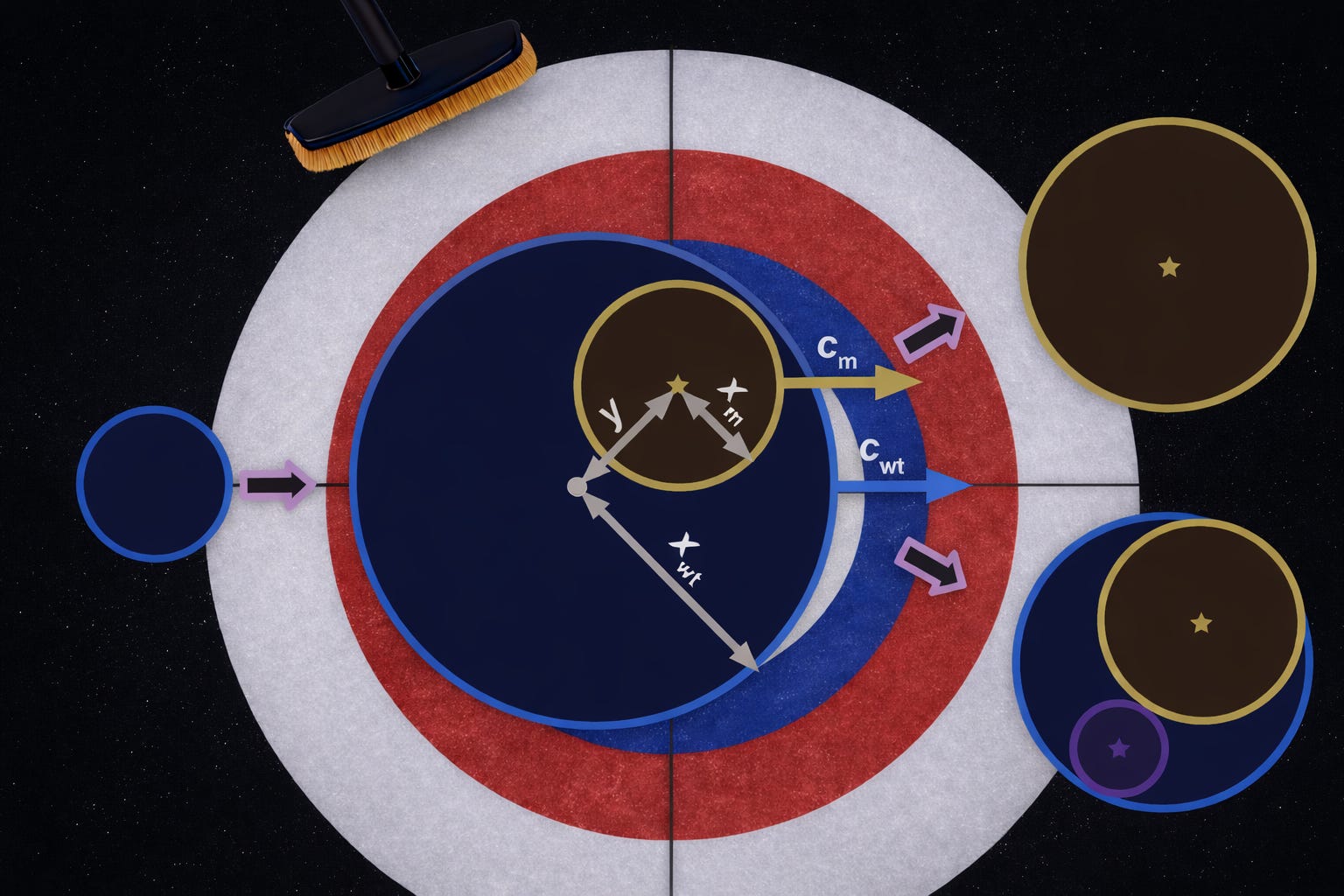
Based on the paper: Selective sweep probabilities in spatially expanding populations published in Nature Communications
Artist: Robert Noble (@robjohnnoble) assisted by ChatGPT.
Caption: Success in a sport like curling depends not only on how much stronger you are than your competitors but also very much on luck. Likewise in biological evolution. The multistep genetic model of cancer development posits that tumours overcome physiological constraints and become more aggressive by successively acquiring driver mutations. If a fitter mutant cell lineage can disperse within a tumour then, in principle, it might eventually spread and outcompete all other lineages, thus achieving a selective sweep (upper right in the image). Alternatively, another mutant of similar fitness might arise and block the advance of the first mutant via clonal interference (lower right). To investigate which scenario is most likely, we analysed a macroscopic, stochastic model to obtain simple expressions for sweep probabilities in one, two and three dimensions. We ran extensive agent-based simulations to test the robustness of these results, which are equally applicable to other expanding, evolving populations such as bacterial colonies and invasive species. A post on the Mathematical Oncology Blog explains more about our study and a Behind the Paper post tells the story of how this project evolved from master’s thesis to published paper.

Visit the mathematical oncology page to view jobs, meetings, and special issues. We will post new additions here, but the full list can found at mathematical-oncology.org.
1. Jobs
Approximate current subscriber count, N:
N(t) = 0.808t+80 (where t = days since Dec. 1st, 2017)