
This week in MathOnco 363
Math Onco Books! & more


“This week in Mathematical Oncology” — March 12, 2026
> mathematical-oncology.org
From the editor:
Each and every year, the team at mathematical-oncology.org strives to provide a new resource for the community (and maintain the current resources!). We’re excited to announce the newest resource: Math Oncology Books page!
Special thanks to Sandhya Prabhakaran, M A Masud, and Daniel Camacho Gomez for their help organizing the new book page!
Enjoy,
Jeffrey West
jeffrey.west@moffitt.org
TWiMO is brought to you by Maximilian Strobl, Sarah Groves, Veronika Hofmann, Yifan Chen, Franco Pradelli, and Sandy Anderson. Find out more about the team here.

Tumor mutational burden shapes success and resistance in cancer immunotherapy.
Aguadé-Gorgorió G.Growth kinetics of high-grade serous ovarian cancer: implications for early detection
Bharath Narayanan, Thomas Buddenkotte, Hayley Smith, Mitul Shah, Susan Freeman, David Hulse, Gabriel Funingana, Marie-Lyne Alcaraz, Mireia Crispin-Ortuzar, James Brenton, Paul Pharoah & Nora PashayanSSRCA: A Novel Machine Learning Pipeline to Perform Sensitivity Analysis for Agent-Based Models.
Rohr EH, Nardini JT.Tumor organoids modeling reveals timed responses and interplay of radiotherapy and chemotherapy in pancreatic cancer.
Yang C, Keepers Z, Shukla HD, Ren L.

A Computational Model of Tumor Interactions with Bone-Resident Cells Predicts Tumor-Type-Specific Responses to Perturbations.
Vega AG, Bennett NE, Beadle EP, Alshafeay S, Chitturi R, Nagarimadugu A, Villur H, Jaiswal A, Rhoades JA, Harris LA.Deciphering selection patterns of somatic copy-number events
Tom L. Kaufmann, Adam Streck, Florian Markowetz, Peter Van Loo, Roland F. Schwarz

Mechanistic and data-driven modeling in mathematical oncology
Special Issue in npj Systems Biology & Applications (Deadline Dec 2):The field of Mathematical Oncology is defined by the use of interpretable mathematical models that integrate clinical and biological knowledge and data for the purpose of understanding cancer evolution and therapeutic response, with the ultimate goal of predicting tumor progression and optimizing treatment for each individual patient. We welcome contributions on data-driven approaches that address common challenges in mathematical oncology.
Cancer Population Genetics Club (CANPOP) - Meeting 2
Event Timing: June 15th, 2026 13:00 (UK time)
Event Address: 123 Old Brompton Rd, South Kensington, London SW7 3RP
CANPOP is a new initiative of the Centre for Evolution and Cancer at the ICR in and aims to provide an informal platform to bring together researchers interested in integrating theory and data to better understand how cancers evolve. After a
fantastic turnout at our first meeting in December, this second edition will feature a series of short presentations from selected abstracts and a keynote from Martin Taylor (University of Edinburgh).

The newsletter now has a dedicated homepage where we post the cover artwork for each issue, curated by Maximilian Strobl, Sarah Groves, and Veronika Hofmann. We encourage submissions that coincide with the release of a recent paper from your group. This week’s artwork:
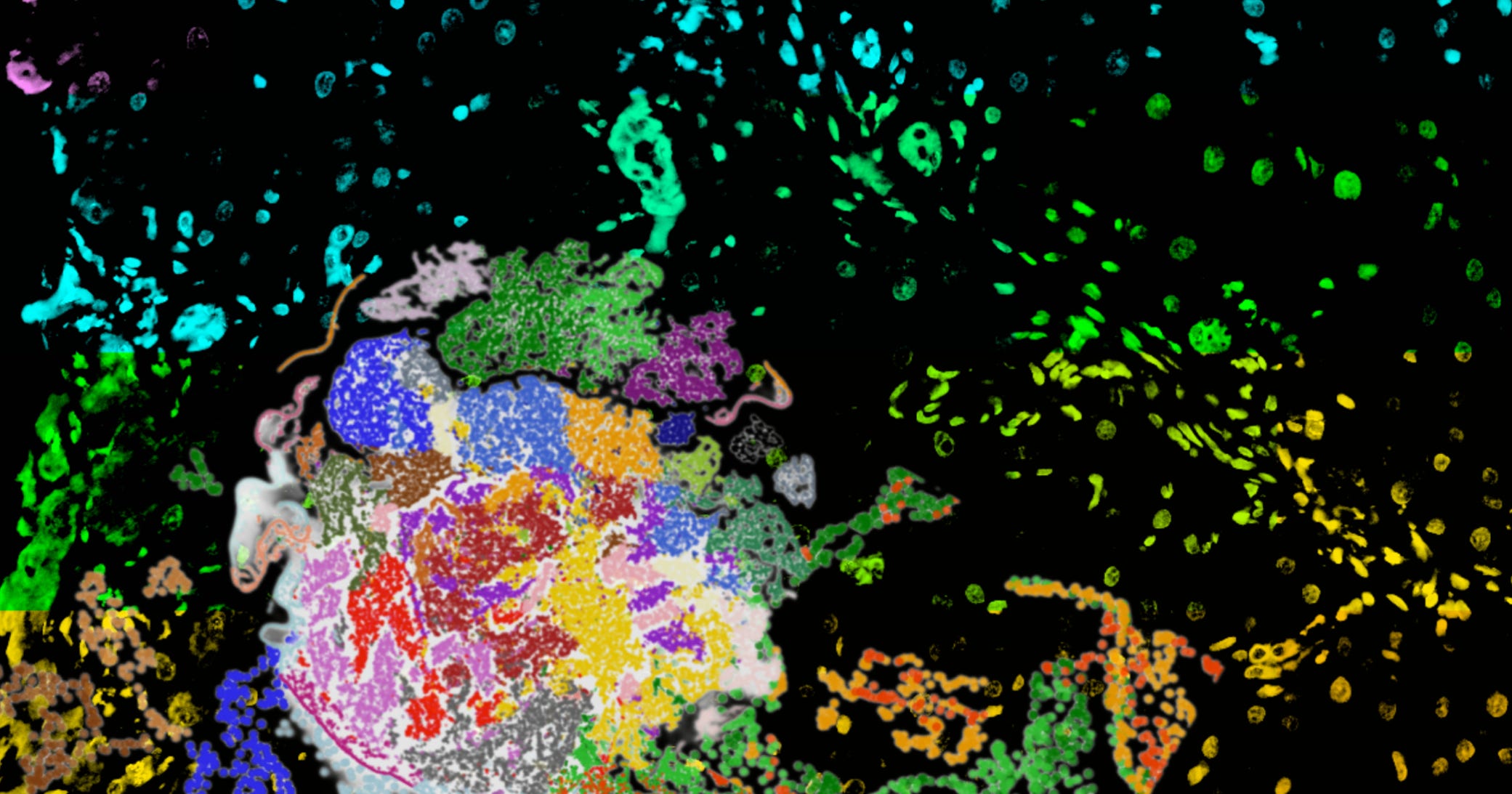
Based on the paper: Distinct Tumor-Immune Ecologies in Patients with Lung Cancer Predict Progression and Define a Clinical Biomarker of Therapy Response published in Cancer Research
Artist: Sandhya Prabhakaran (@sandhya212), Chandler Gatenbee (@cgatenbee), and Alexander Anderson (@ara_anderson)
Caption: Multiscale Spatial Analysis (MSA) involves extracting and examining spatial information from data across multiple scales—such as images, quadrats, and cells. This cover art provides a conceptual visualization of MSA using multi-stain images from Lung cancer. The background image is a risk map: a single multi-stain image depicting gradients of disease-progression probabilities, computed by inferring the spatial neighborhoods of cells and quadrats. The foreground features a collage of t-SNE renderings of cells and quadrats extracted from several such multi-stain images. In our paper, we show that integrating localized information with a broader spatial context can improve predictions of disease progression.

Visit the mathematical oncology page to view jobs, meetings, and special issues. We will post new additions here, but the full list can found at mathematical-oncology.org.
1. Jobs
Approximate current subscriber count, N:
N(t) = 0.808t+80 (where t = days since Dec. 1st, 2017)