
This week in MathOnco 371
Aging, metastasis, excitability, and more...


“This week in Mathematical Oncology” — May 14, 2026
> mathematical-oncology.org
From the editor:
One paper that caught my interest is the Nature Genetics paper on age vs selection. It shows the importance of direct comparison between cancer and its normal, healthy counterpart. For example, NOTCH1 might be under positive selection in some cancers, but is even more frequently mutated in normal tissue. This suggests an inhibitory effect on carcinogenesis, despite positive selection in cancer!
Enjoy,
Jeffrey West
jeffrey.west@moffitt.org
TWiMO is brought to you by Maximilian Strobl, Sarah Groves, Veronika Hofmann, Yifan Chen, Franco Pradelli, and Sandy Anderson. Find out more about the team here.

Evolutionary characterization of lung cancer metastasis.
Hessey S, […], Jamal-Hanjani M.Excitability as a design principle in the immune system.
Lebel Y, Alon U.Age distinguishes selection from causation in cancer genomes
David Cheek, Martin Blohmer, Martin A. Nowak, Tibor Antal, Kamila NaxerovaRethinking the role of synergy calculations in the next century of drug combination discovery
Christian T. Meyer, Yunxing Dai, Amy E. Pomeroy, …, Anang A. Shelat, Malcolm A. Smith, Adam C. PalmerSimulating Cancer Recurrence Patterns From Post-Treatment Viable Tumor Burden Distributions
Mohammad U. Zahid, Joseph D. Butner, David M. Swanson, , David A. Hormuth II, and Heiko EnderlingPersonalized optimal dosing strategies for anticancer chemotherapy using mathematical modeling
Yunil Roh, Sooyoun Choi, Yong Dam Jeong, Jong Hyuk Byun & Il Hyo JungThe Fitness Cost of Therapeutic Resistance in Cancer: A Systematic Review
Bailey Kane
Policy Gradient Methods for Non-Markovian Reinforcement Learning
Avik Kar, Siddharth Chandak, Rahul Singh, Soumitra Sinhahajari, Eric Moulines, Shalabh Bhatnagar, Nicholas BambosExtrachromosomal DNA Gives Cancer a New Evolutionary Pathway.
Brunk E, …, Slade L.

Many of the deepest challenges in advancing AI for scientific discovery are not purely technical—they are social and organizational. Progress is often limited not by algorithms or computational power, but by how effectively we coordinate efforts, share resources, and collaborate across disciplinary boundaries. Hugging Science brings together a global community of researchers, developers, and practitioners committed to accelerating breakthroughs in physics, biology, chemistry, neuroscience, and beyond through open collaboration. Our vision is grounded in the argument presented in our position paper: democratizing AI for science requires treating it as a collective social project where equitable participation and sustainable collaboration are prerequisites for technical progress.
The newsletter now has a dedicated homepage where we post the cover artwork for each issue, curated by Maximilian Strobl, Sarah Groves, and Veronika Hofmann. We encourage submissions that coincide with the release of a recent paper from your group. This week’s artwork:
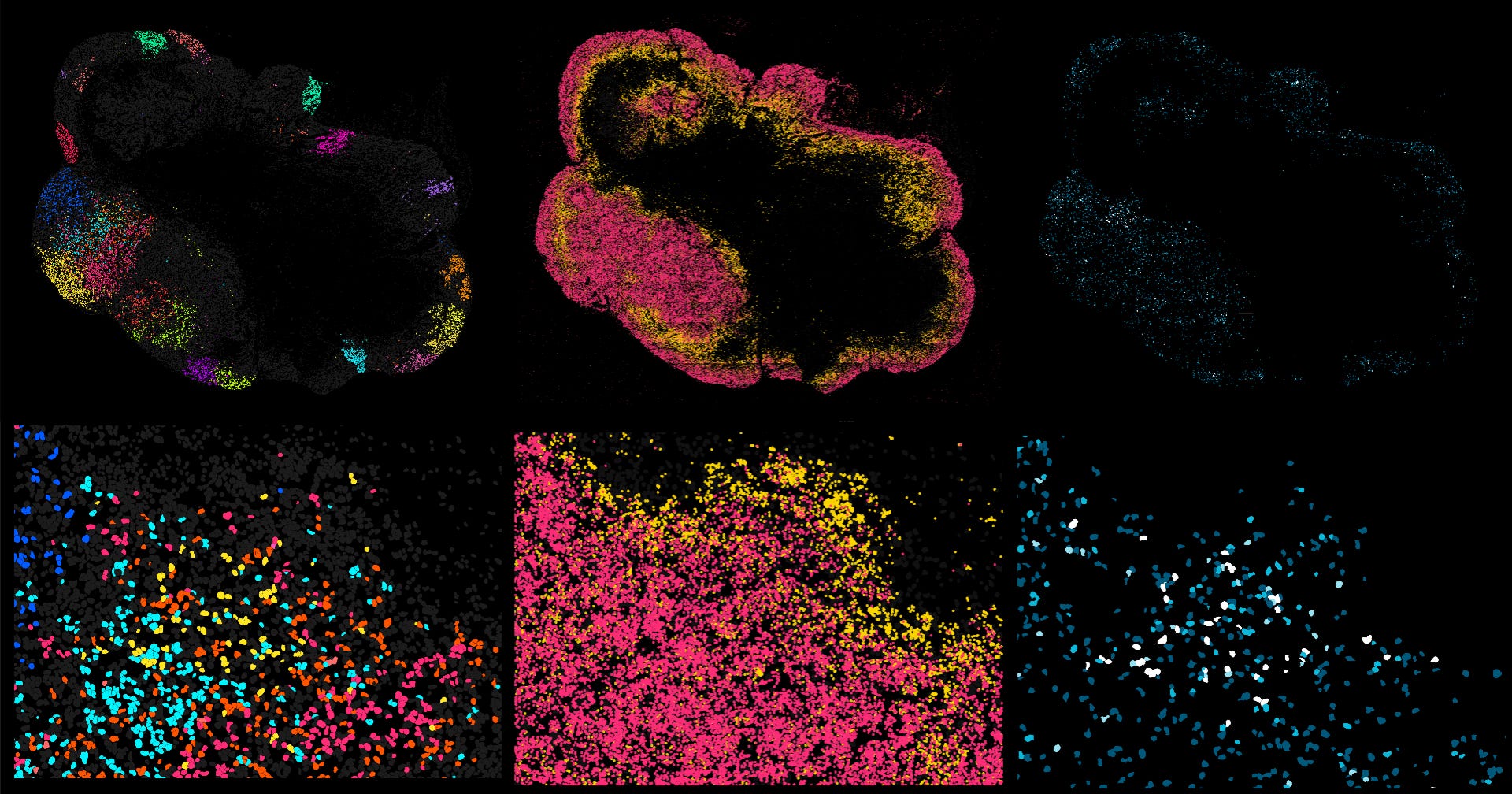
Based on the paper: SpaceBar enables single-cell-resolution clone tracing with imaging-based spatial transcriptomics published in Nature Methods.
Artist: Grant Kinsler (@GrantKinsler, @grantkinsler.bsky.social)
Caption: A cell’s function is determined by both its ancestry and location within a tissue. New developments in imaging-based spatial transcriptomics now allow us to measure gene expression at high-resolution and precision within a cell’s spatial context but are incompatible with random-barcode-based clone tracing. We developed a new method for clone tracing that’s compatible with these approaches, allowing for high-resolution clone and gene expression measurements in spatial context. The art, somewhat inspired by Andy Warhol, shows the same tumor (top) with clonal information, genes that are driven by spatial patterns, and a gene that is driven by clonal patterns. The bottom panels show a zoomed-in location for the same tumor.

Visit the mathematical oncology page to view jobs, meetings, and special issues. We will post new additions here, but the full list can found at mathematical-oncology.org.
1. Jobs
Approximate current subscriber count, N:
N(t) = 0.808t+80 (where t = days since Dec. 1st, 2017)