
This week in MathOnco 376
The authors’ attention was drawn to the present problem.....


“This week in Mathematical Oncology” — July 23, 2026
> mathematical-oncology.org
From the editor:
Most academics who are also writing fanatics typically leave two tasks for the end of the writing process: 1) the title and 2) the first sentence. Both require broad (but specific) contextualization of a body of work with a limited economy of words. In particular, the first sentence should be a kind of sing-songy, pleasant phrase that piques the interest while rolling off the tongue. Yet it can’t be overwrought or bombastic — even so, one ought to put their work in the broadest possible context. The strategy has changed over time too. Older papers might describe how one stumbled upon the problem: “The authors’ attention was drawn to the present problem by an interesting discussion at the New York statistical meetings in December 1949.” [1] Modern publications prefer dense language with broad application: “The age-related mortality curve for modern humans is an outlier across the tree of life, with an abrupt increase in mortality after the average lifespan, leading to surprisingly low variance in age at death.” [2] What’s your favorite first sentence?
Fix, Evelyn, and Jerzy Neyman. "A simple stochastic model of recovery, relapse, death and loss of patients." Human Biology 23.3 (1951): 205-241.
Mitchell, Emily, et al. "Clonal dynamics of haematopoiesis across the human lifespan." Nature 606.7913 (2022): 343-350.
Enjoy,
Jeffrey West
jeffrey.west@moffitt.org
TWiMO is brought to you by Maximilian Strobl, Sarah Groves, Veronika Hofmann, Yifan Chen, Franco Pradelli, and Sandy Anderson. Find out more about the team here.

Evolution of clonal hematopoiesis during cancer treatment and its impact on outcomes
Mona Arabzadeh, Yi-Han Tang, Christelle Colin-Leitzinger, Sadegh Marzban,… Jeffrey West, Shridar Ganesan, Hossein Khiabanian, Nancy GillisBifurcation analysis of the tangential switching mode in a non-monotonic tumor growth model
Tiago Carvalho, Diego S. Rodrigues, Durval J. TononCoupled SDE-ODE Modeling of Tumor-Immune Dynamics to Infer Biomarker Release
Pujan Shrestha, Yijia Fan & Jason T. GeorgeA Hallmark-Integrated, Agent-Based Framework for Intratumor Heterogeneity in Melanoma Evolution
Khola Jamshad, Trachette L. JacksonAccurate detection of tumor clonality and ongoing expansion mode from genomic data
Yanjie Chen, Roman Jaksik, Peter Terranova, Sara El Baghdadi, Andrew Koval, Monika K. Kurpas, Simon Tavaré, Marek Kimmel, Khanh N. DinhData-driven system identification in cancer systems biology: A multiscale modeling approach to melanoma
Chase Christenson , Siva Viknesh, Robert L. Judson-Torres , Amirhossein ArzaniTowards the construction of a virtual yeast.
Qian L, … Guo T.Repeatability of an MRI protocol for generating habitats based on cellularity, perfusion, and hypoxia in a murine model of glioma.
Das A, Hormuth DA 2nd, Virostko J, Parker P, Quarles C, Yankeelov TE.Validation of AI-enabled surrogate models in quantitative systems pharmacology: a practical, context-of-use-driven review.
Goryanin I, Goryanin I.Exploring the relationship between vascular remodelling and tumour growth using agent-based modelling
Nic Fan, Joshua Bull, Helen ByrneSystems biology during 20 years of PLoS Computational Biology
Mark Alber,Marc R. Birtwistle,Stacey D. Finley ,Pedro Mendes

Lineage-aware stochastic modeling reveals gene-expression dynamics in development and disease.
Xing J, Staklinski SJ, Liu Z, Nowak D, Siepel A.Receptor-structured modelling of EGFR-driven tumor initiation: from spatially resolved cell-based simulations to reduced population dynamics
Romasa Qasim, Anass BouchnitaCellular turnover can increase or decrease the mutant burden in expanding cell population
Samrat S. Mondal, Natalia L. Komarova, Dominik Wodarz

The newsletter now has a dedicated homepage where we post the cover artwork for each issue, curated by Maximilian Strobl, Veronika Hofmann, Yifan Chen, and Sarah Groves. We encourage submissions that coincide with the release of a recent paper from your group. This week’s artwork:
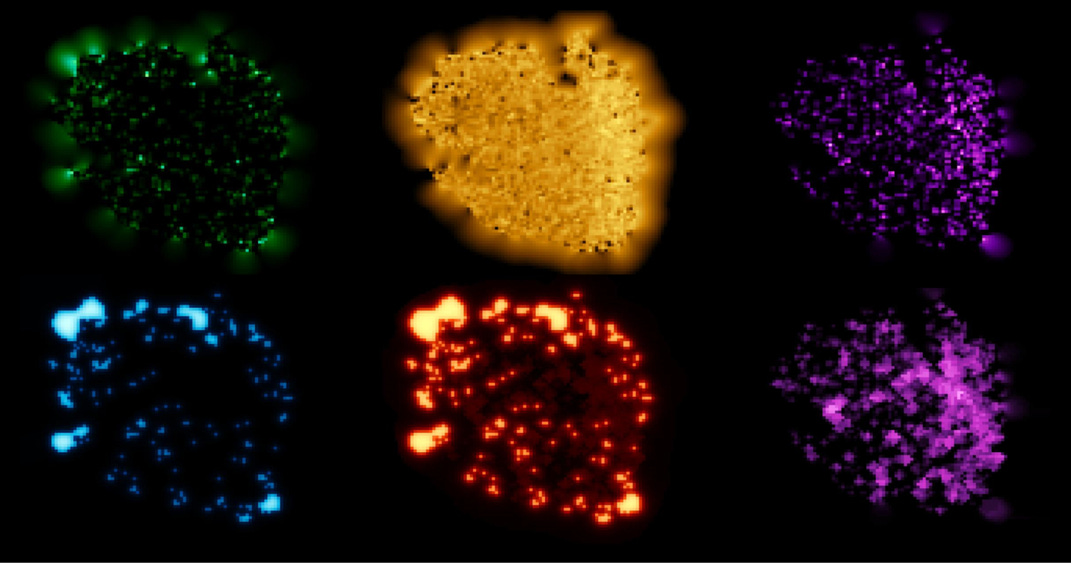
Based on the paper: Mathematical dissection of tumor phenotypic heterogeneity in a spatial data-informed nonlocal reaction-diffusion model published in the Journal of Mathematical Biology
Artist: Hui Li
Caption: Tumors are not uniform masses; they contain cells with vastly different phenotypes, a feature that complicates treatment and drives drug resistance. This artwork, adapted from our spatial data‑informed nonlocal reaction‑diffusion model, shows how tumor cells evolve across space in response to oxygen availability. The upper panels depict initial patient data from a glioblastoma sample: blood vessel locations, tumor cell density, and the mean phenotypic state (based on HIF gene expression). The lower panels reveal the model’s steady‑state predictions: oxygen concentration, local cell density, and the resulting mean phenotypic state. Near blood vessels, oxygen supply is high, favoring aerobic phenotypes (low HIF); far from vessels, hypoxia dominates, pushing cells toward a high‑HIF state. By integrating spatial transcriptomics into a rigorous mathematical framework, our work uncovers how vascular clustering and tumor‑vessel proximity shape long‑term phenotypic heterogeneity. Such model‑data integration offers a powerful lens to predict tumor evolution and design spatially‑adaptive therapies.
No generative AI was used in creating this image.

Visit the mathematical oncology page to view jobs, meetings, and special issues. We will post new additions here, but the full list can found at mathematical-oncology.org.
1. Jobs
Approximate current subscriber count, N:
N(t) = 0.808t+80 (where t = days since Dec. 1st, 2017)