
This week in MathOnco 377
A call to the math onco group leaders


“This week in Mathematical Oncology” — July 30, 2026
> mathematical-oncology.org
From the editor:
At the time of writing, the TWiMO newsletter has subscribers in 43 US states and 86 countries. The geographic distribution of math oncology enthusiasts roughly co-localizes with the location of scientific research more broadly. But I fear that we are still yet underestimating our list of Group Leaders. If you would like your group to be featured on this page, please consider reaching out with the information requested (see the process on the linked page above). Our one request — we ask featured Group Leaders to begin contributing to the Mathematical Oncology blog regularly. This helps generate content for the blog, which we hope will inspire interesting scientific discussion, too.
Enjoy,
Jeffrey West
jeffrey.west@moffitt.org
PS check out the new job opening below in Kathleen Wilkie's group!
TWiMO is brought to you by Maximilian Strobl, Sarah Groves, Veronika Hofmann, Yifan Chen, Franco Pradelli, and Sandy Anderson. Find out more about the team here.

Evolutionary antifragile therapy is a treatment strategy to suppress drug resistance by exploiting dose response convexity
Jeffrey West, Bina Desai, Maximilian A. R. Strobl, Jill Gallaher, Mark Robertson-Tessi, Andriy Marusyk, Alexander R. A. AndersonQuantitative calibration of a spatial QSP model identifies fibroblast impact on HCC immunotherapy.
Zhang S, Wang H, Cho Y, Rocha HL, Wong W, Yarchoan M, Jaffee EM, Ho WJ, Kagohara LT, Fertig EJ, Popel AS, Deshpande A.Spatial Configuration of Pancreatic Cancer Is Associated with Disease Recurrence after Neoadjuvant Therapy and Curative-Intent Resection
Luis H Cisneros, Merih D Toruner, Zafar Siddiqui, Andrea V Maraone, …, Paul Dizona, Qian Shi, Martin E Fernandez-Zapico, Ryan M CarrMoCaPS: a machine learning model for stratification of cancer-associated cachexia based on blood biomarkers.
Olumoyin KD, Park M, Davis EW, Permuth JB, Rejniak KA.Fluorescence tracking CD8 T cells from tumor-draining lymph nodes to irradiated tumors and their activation in the tumor environment.
Friedman D, Kramer G, Alice AF, Baird J, Ramin S, Medler T, Young KH, Kaiser MG, Grassberger C, Crittenden MR, Gough MJ.Comprehensive Genomic Analysis of Normal and Cancer Cells Elucidates the Elevated Mutation Burden in Cancer
Sophie Pénisson, Kameron Bates, Kunjur Manasa Upadhyaya, Kamel Lahouel, Mete Mülazımoğlu, Louka Monteiro de Sousa, Isaac Kohane, Jeffrey M. Trent, Bert Vogelstein, Cristian TomasettiKayode D. Olumoyin, Magaret Park, Evan W. Davis, Jennifer B. Permuth & Katarzyna A. Rejniak
Hazard curvature makes within-host variability costly for survival
Hitesh B. MistryA Bayesian framework for longitudinal EHR and genetic discovery
Sarah M. Urbut, Yi Ding, Tetsushi Nakao, Satoshi Koyama, Anika Misra, Xilin Jiang, Achyutha Harish, Leslie Gaffney, Whitney E. Hornsby, Jordan W. Smoller, Alexander Gusev, Pradeep Natarajan & Giovanni Parmigiani

Oxygenation and spatial heterogeneity shape radiotherapy protocol ranking through phenotypic adaptation
Francesco Albanese, Giulia Chiari, Marcello Edoardo Delitala

Open Letter to the University of Dundee in response to its plans to end undergraduate mathematics
Professor Beatrice Pelloni, President, Edinburgh Mathematical Society and Heriot Watt University, U.K.Professor Mark Chaplain, President, London Mathematical Society and University of St Andrews, UK
Using Math to Help Treat Brain Cancer
Frontiers for Young Minds
Nicholas Harbour, Lee Curtin, Kyle W. Singleton, Matthew E. Hubbard, Markus R. Owen, Kristin R. SwansonThink preprints are unreliable? Analysis of 70,000 studies might change your mind
”Central conclusions rarely change when biomedical preprints go on to be published in journals.”

The newsletter now has a dedicated homepage where we post the cover artwork for each issue, curated by Maximilian Strobl, Veronika Hofmann, Yifan Chen, and Sarah Groves. We encourage submissions that coincide with the release of a recent paper from your group. This week’s artwork:
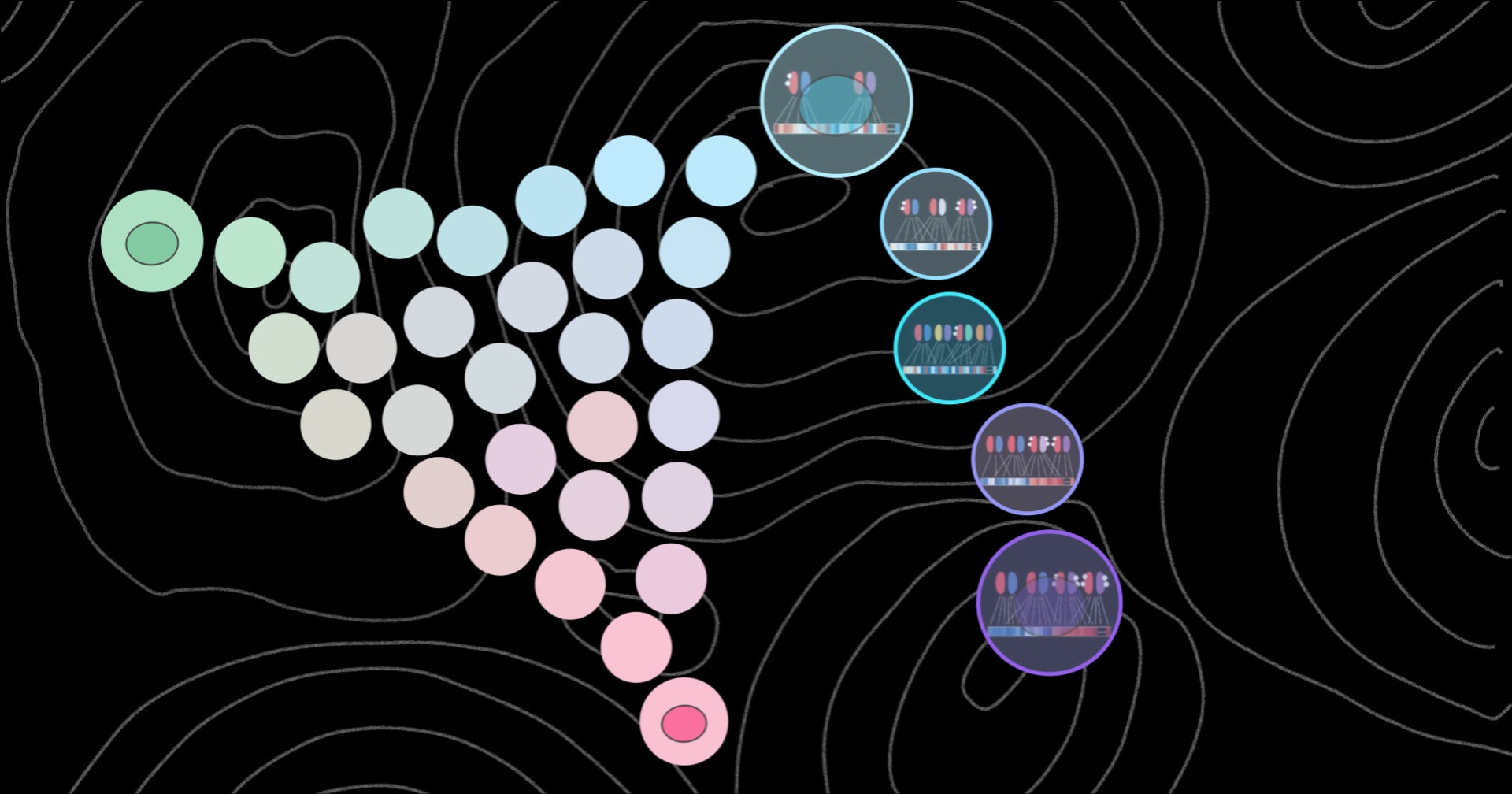
Based on the paper: A mechanism for adaptive genome regulation in cancer published in Nature.
Artists: Gustavo S. França (LinkedIn) and Itai Yanai (X, LinkedIn)
Caption: Cancer cells have a remarkable capacity to survive therapeutic pressure by reprogramming themselves in response to environments that would otherwise be lethal. This study investigates the molecular principles underlying such adaptive behavior. The authors propose that cells learn how to adapt to a stressful environment through a process analogous to an evolutionary search strategy, dynamically testing distinct regulatory states and reinforcing those that alleviate cellular stress. Central to this model is the AP-1 transcription factor network, which is suggested to function as a molecular system capable of encoding and stabilizing adaptive, drug-tolerant cellular states.

Visit the mathematical oncology page to view jobs, meetings, and special issues. We will post new additions here, but the full list can found at mathematical-oncology.org.
1. Jobs
Approximate current subscriber count, N:
N(t) = 0.808t+80 (where t = days since Dec. 1st, 2017)