
This week in MathOnco 378
Spatial modeling: Turing's legacy in mathematical oncology


“This week in Mathematical Oncology” — August 6, 2026
> mathematical-oncology.org
From the editor:
Since reading Alan Turing: The Enigma, I have often returned to one remarkable fact: Turing, widely regarded as one of the fathers of computer science, also made foundational contributions to spatial biological modeling. Think about it: you just laid the foundation of computer science and what is the first thing you do? You try to understand how simple chemical interactions could generate the complex structures we see in nature, from the arrangement of leaves to the stripes of a zebra.
I often think that the love of computation, paired with a sensibility for the spatial arrangement of life, is something Turing helped initiate, and it has never truly faded from the Mathematical Oncology community.
In our recent work, we observed that once computational tools became broadly available, spatial modeling rapidly emerged across the scientific landscape. Today, it represents one of the dominant themes in Mathematical Oncology, cutting across many of its major research directions. This is closely connected to the growing understanding of cancer as a complex, evolving ecosystem: a view that mathematical modeling has been uniquely well suited to formalize, explore, and challenge over the past three decades.
Still, I like to imagine that part of this intellectual lineage began with a brilliant mathematician looking at the patterns of leaves in a garden, and asking the most powerful question in science: why?
Enjoy,
Franco Pradelli
franco.pradelli@moffitt.org
TWiMO is brought to you by Maximilian Strobl, Sarah Groves, Veronika Hofmann, Yifan Chen, Franco Pradelli, and Sandy Anderson. Find out more about the team here.

Quantifying target antigen-dependent CAR T-cell performance against AML
Saumil Shah, Jan Mueller, Emanuel Vogel, Michael Raatz, Steffen Boettcher, Arne Traulsen, Markus G. Manz & Philipp M. AltrockGenetic background sets the trajectory of experimental cancer evolution.
Aitken SJ, …, Odom DT.Mathematical modeling of T cell exhaustion in the tumor microenvironment. Pharmacol Ther.
Adeniyi-Aogo TE, Talkington AM.The ctDNA Paradigm: Dynamic Observation, Quantitative Analysis, and Interpretive Limits in Precision Oncology.
Chetta M, Bukvic N, Rosati A.Engineering therapeutic super-competitor cells for educative cancer treatment and ecological replacement
Youzhi Wang, Ning Wu, Yihao Liao, Junbo Li, Changchang Li, Jiaming Liang, Diansheng Zhou, Liyuan Ge, Xiaobo Chen, Shudong ZhangMathematical modeling of T cell exhaustion in the tumor microenvironment
Toluwalope E. Adeniyi-Aogo, Anne M. TalkingtonThe hybrid preclinical ecosystem: a strategic road map for oncology clinical translation
Wonbeak YooLDAcoop: Integrating non-linear population dynamics into the analysis of clonogenic growth in vitro
Nikko Brix, Daniel Samaga, Katharina Gehr, Benedek Dankó, Mohamed Schumann, Guido Drexler, Ahmed Alnatsha, Georg Beyer, Ujjwal Mahajan, Martin Selmansberger, Julia Mayerle, Claus Belka, Horst Zitzelsberger, Kirsten LauberProject Optimus for Radiation Therapy–Drug Combinations: Moving Beyond the Maximum Tolerated Dose
Alastair Greystoke, Sarah Brown, Anthony Chalmers, Jamie A. Dean, …, Richard Myers, Jamie Oughton, Karl T. Butterworth, Corinne Faivre-Finn
Fluctuating environment causes neoplastic transition and epithelial-mesenchymal plasticity in human cells
Erez Persi, Rafael Canevarolo, Praneeth Reddy Sudalagunta, Liping Xu, Khadijeh Karbalaei, Gulden Olgun, Yuri Wolf, Sridhar Hannenhalli, Eugene Koonin, Ariosto Siqueira Silva

The Country’s First Dedicated Mathematical Oncology Initiative
Seemab Mehmood: ”Cancer is increasingly understood as a complex, dynamic, and evolving system. Mathematical models provide a powerful framework for studying tumor growth, treatment response, and disease progression, complementing experimental and clinical research with quantitative insight. While mathematical oncology has grown rapidly in many parts of the world, this interdisciplinary field remains largely unexplored in Pakistan. We are delighted to introduce the MathOnco Community to MoLab Pakistan (Mathematical Oncology Lab Pakistan), a newly established initiative based at Fatima Jinnah Medical University in Lahore, Pakistan. Our goal is to cultivate a collaborative environment where mathematics, oncology, computational science, and medicine converge to address cancer-related challenges relevant to our region while contributing to the broader international mathematical oncology community.”

The newsletter now has a dedicated homepage where we post the cover artwork for each issue, curated by Maximilian Strobl, Veronika Hofmann, Yifan Chen, and Sarah Groves. We encourage submissions that coincide with the release of a recent paper from your group. This week’s artwork:
Based on the paper: MISSTE: a multiscale integrative spatial simulator for understanding the mechanisms underlying tissue ecosystems published in Computers in Biology and Medicine
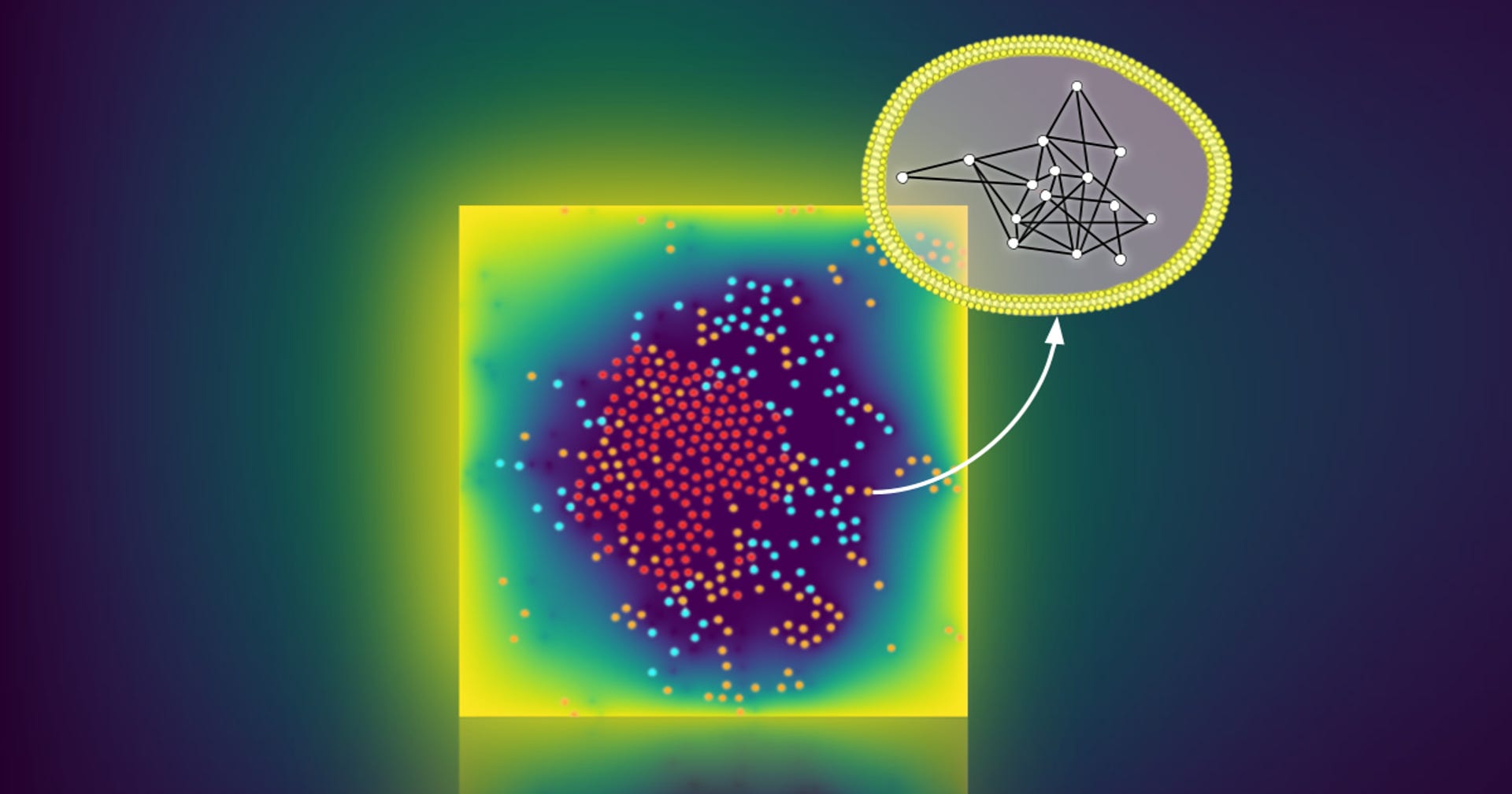
Artist: Claire He
Caption: We developed MISSTE, a multiscale integrative spatial simulator to model tissue ecosystems. The colored heat map in the figure represents dynamic microenvironmental fields during simulations, while the scattered cells show agent-based cell movement and interactions. The network inside the tissue-like boundary suggests intracellular decision logic, where cells respond to signals such as oxygen, cytokines, suppression, and contact with other cells. We applied MISSTE to explain complex behavior of CAR-T therapy for solid tumors, including limited tumor penetration, stromal suppression, hypoxia, cytokine remodeling, and T-cell exhaustion.

Visit the mathematical oncology page to view jobs, meetings, and special issues. We will post new additions here, but the full list can found at mathematical-oncology.org.
1. Jobs
Approximate current subscriber count, N:
N(t) = 0.808t+80 (where t = days since Dec. 1st, 2017)